Key takeaways
- Temporary abandonment is a regulated condition used when a well may be needed for proper lease development or production. It requires BSEE approval, barriers, testing and—in applicable shallow water—protection and inspection.
- Unlike permanent abandonment, temporary abandonment does not require the operator to sever casing, remove the wellhead or complete final site clearance. Those items can remain as future observable scope.
- If the operator or BSEE determines continued temporary abandonment is no longer necessary, 30 CFR 250.1723 requires prompt permanent plugging, removal of remaining casing-stub or mudline equipment and site clearance.
- A temporary-abandonment record is not a tender signal by itself. Commercial timing depends on continued usefulness, the operator's plans, the lease and Idle Iron clocks, later filings and verified procurement.
“Abandoned” sounds final. In offshore well records, it may describe two materially different states.
A permanently abandoned well has moved through the final plugging requirements, wellhead and casing disposition, and the completion evidence used to close the obligation. A well in temporary abandonment—often shortened to TA in BSEE and industry records—has been secured so it can remain safely out of operation while the operator retains a legitimate reason to re-enter it. Work has been performed, but the final decommissioning sequence may still remain.
For a P&A contractor, that makes the temporarily abandoned well inventory relevant—and easy to misread. It can represent future work. It does not by itself establish current timing, an open procurement process or a full untouched P&A scope.
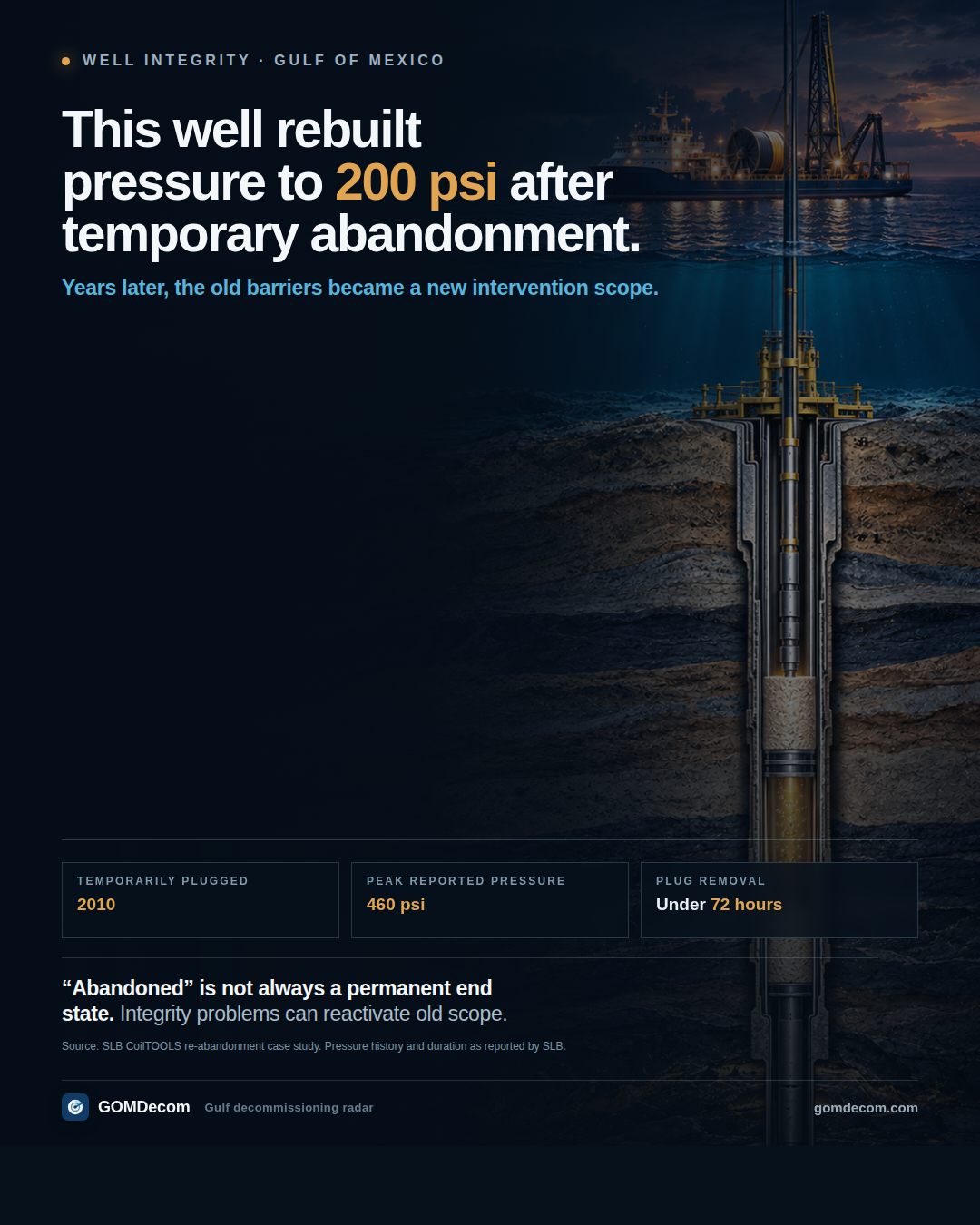
One re-abandonment example shows why an old temporary condition may become active intervention scope. Source: SLB CoilTOOLS case study; pressure history and duration as reported by SLB.
What temporary abandonment legally means
30 CFR 250.1721 allows an operator to temporarily abandon a well when doing so is necessary for proper development and production of the lease. The operator must submit form BSEE-0124, Application for Permit to Modify, provide the required supporting information and receive approval from the appropriate District Manager.
Temporary abandonment is not permission to walk away from an open hole. The regulation requires much of the same barrier discipline used for permanent plugging, including specified plugs, testing and two independent barriers in the center wellbore. It also requires operators to identify subsea wellheads and other obstructions and, in applicable water depths, protect them through an approved device or structure.
The important difference is what the operator does not need to finish at the temporary-abandonment stage. Section 250.1721 states that the operator does not need to sever the casings, remove the wellhead or clear the site. Those are precisely the physical items that can reappear later as remaining decommissioning scope.
Temporary abandonment is a maintained interim condition backed by barriers and approvals—not a synonym for permanent completion.
The work already performed versus the work remaining
Treating a temporarily abandoned well as untouched inflates the addressable package. Treating it as complete removes real future work. A sound commercial reading separates the two.
Work that may already be present in a compliant temporarily abandoned condition includes:
- isolation of hydrocarbon and other relevant zones;
- bridge or cement plugs at required positions;
- pressure or weight testing of specified plugs;
- a protected subsea wellhead or casing stub;
- engineering certification and an approved BSEE-0124 filing.
Work that may remain for final abandonment includes:
- final plug work required by the approved permanent-abandonment design;
- severing casing and removing the wellhead;
- removing protective devices or mudline suspension equipment;
- cutting casing to the required depth below the mudline; and
- site-clearance work and verification.
30 CFR 250.1716 sets the standard wellhead and casing removal depth at least 15 feet below the mudline unless BSEE approves an alternate depth under the listed conditions. That physical difference—hardware left safely in place during temporary abandonment versus removed or cut below the seafloor for final disposition—is one reason an inventory of these wells continues to matter commercially.
Temporary abandonment also carries a maintenance burden
Temporary does not mean unattended. The rules require reporting and, depending on water depth and protection method, continuing inspection.
For subsea protective devices, 30 CFR 250.1722 specifies design and trawl-test requirements intended to prevent the remaining equipment from becoming a hazard. The same section requires annual reporting on plans to re-enter and complete the well or permanently plug it, and in relevant shallow-water cases requires annual visual inspection or trawl testing of the protection.
That produces a commercial nuance: this interim condition can create inspection, intervention and integrity needs before final P&A. Those services are not interchangeable with the permanent-abandonment package, and the public record may not reveal how they are procured.
What ends temporary status
The status remains legitimate only while maintaining the well in that condition is necessary for proper development or production. When the operator or BSEE determines it is no longer necessary, 30 CFR 250.1723 requires three things:
- promptly and permanently plug the well under §250.1715;
- remove casing-stub or mudline suspension equipment and any subsea protective covering under an approved BSEE-0124 request; and
- clear the well site under §§250.1740 through 250.1742.
This is the regulatory handoff from maintained interim condition to final decommissioning. Commercially, the strongest signal is not the old temporary-abandonment label. It is evidence that this handoff is approaching: a permanent-abandonment filing, an approved operation, a scheduled date, an expired lease position or BSEE-driven timing.
How Idle Iron affects the clock
BSEE’s active NTL 2018-G03 explains how the agency interprets wells and platforms that are no longer useful for operations on active leases.
For wells, the guidance uses a two-part concept: the well has not been used in the preceding five years for operations or supporting infrastructure, and the operator has no plans to use it for those purposes. If it is also no longer capable of production in paying quantities, BSEE says the operator should act as soon as possible and generally no later than three years after the well becomes no longer useful.
The guidance permits more than one route within that schedule. The operator may permanently plug and abandon the well, perform the plugging work so only wellhead and casing removal remain, or provide downhole zonal isolation. Where downhole zonal isolation is used, the NTL expects wellhead and casing removal within a further two years, subject to approved alternate plans and case-specific BSEE discretion.
That nuance matters. A five-year idle period is not automatically “five years until a P&A tender,” and the three-year guidance is not a universal fixed start date. Use the standard clock as a screening signal, then check the actual lease, filings and approvals.
Reading temporary-abandonment status in the BSEE data chain
A temporary-abandonment entry should be read with at least four connected record types:
| Question | Evidence to check |
|---|---|
| What operation was approved? | eWell Application for Permit to Modify |
| What work was reported complete? | eWell End of Operations and borehole status |
| Is the well still useful or producing? | Production history, well status and operator context |
| What clock may apply? | Lease status, lease end date and Idle Iron evidence |
The transition is more useful than the label. A TA permit accepted years ago is context. A new permanent-abandonment filing on the same well is motion. An End of Operations record is completion evidence. A cluster of similar transitions across one block may indicate a campaign.
A contractor’s qualification checklist
Before putting a temporarily abandoned well into a P&A forecast, ask:
- Is the well currently recorded as temporarily abandoned, or does the dataset only show historic TA activity?
- Which barriers and hardware disposition were included in the approved operation?
- Is continued re-entry tied to a credible production or development plan?
- Has the well crossed the standard Idle Iron usefulness test or another lease deadline?
- Is a permanent-abandonment APM submitted, accepted or scheduled?
- Has commencement or an EOR already been reported?
- Which other wells and structures make this a plausible campaign?
- Has the operator’s procurement position been verified?
The result will often be “watch,” not “bid.” That is still useful. It puts the correct account and asset into the pipeline before a final filing appears, while keeping the forecast honest.
GOMDecom’s Idle Iron explainer covers the wider clock, and the sample Opportunity Brief shows how temporarily abandoned inventory is separated from permitted permanent-abandonment work and confirmed completion.
Sources
- Electronic Code of Federal Regulations, 30 CFR Part 250, Subpart Q — Decommissioning Activities, especially §§250.1715–250.1716 and §§250.1721–250.1723.
- Bureau of Safety and Environmental Enforcement, NTL 2018-G03 — Idle Iron Decommissioning Guidance for Wells and Platforms (active status checked August 31, 2026).
- Bureau of Safety and Environmental Enforcement, eWell APM Online Query and Data Center.
Put this to work
Track the opportunities behind the analysis.
Gulf decommissioning opportunities identified in monitored BSEE records, ranked by commercial priority and refreshed daily. Or validate a single pursuit with a $19 brief.
GOMDecom aggregates public regulatory data for informational purposes. Figures quoted from third parties are attributed in the text; verify against the cited source before acting. Nothing here is legal, investment or procurement advice.