In short
- Decommissioning is a legal obligation attached to the lease, not a commercial project an operator chooses to run.
- The work splits into four scopes — wells, structures, pipelines, site clearance — each with its own permits and its own contractors.
- Liability is joint and several, so a former owner can be ordered to pay for work on a lease it sold years ago.
- The public record shows scope and timing long before a contract exists. It never shows the contract.
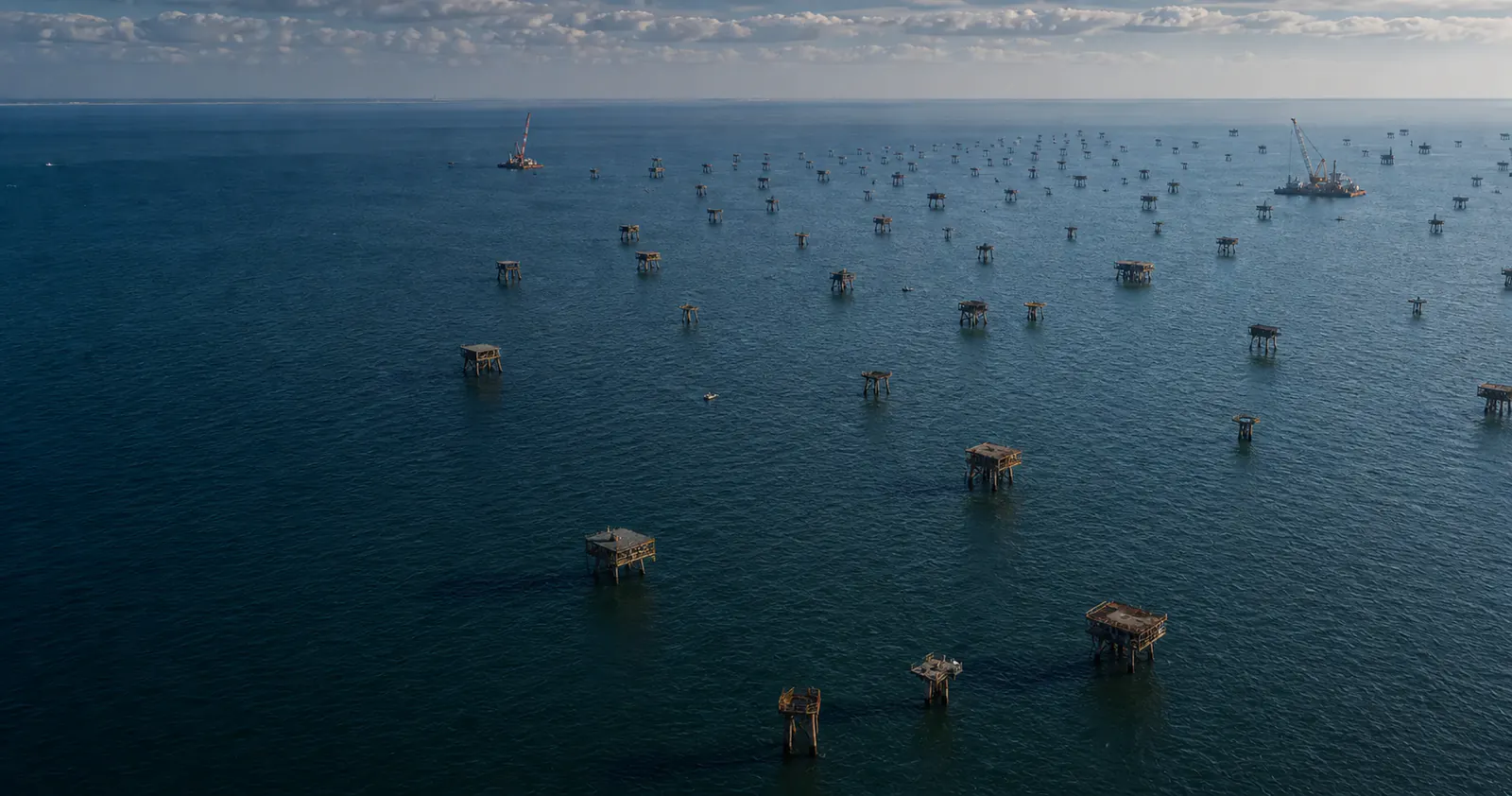
Every offshore structure in the Gulf of Mexico has to come out. The lease that permitted it also obliges the holder to retire it — to plug the wells, remove the platform, deal with the pipelines, and prove the seafloor is clear afterwards.
That obligation is the whole market. It is not demand that rises and falls with the oil price, and it is not work an operator can decline. It is a liability with a regulatory clock attached, and it is the reason decommissioning spending continues through downturns that stop new drilling.
This guide explains how that obligation works, what the work actually consists of, who ends up paying for it, and how the public record shows the work forming before any contract is signed.
The obligation, and why it is different
Most offshore work is discretionary. A company drills because it expects a return. Decommissioning is the opposite: the company spends money to discharge a duty, and the return is that the duty goes away.
Three consequences follow, and they shape everything else.
It does not disappear when production does. A well that stopped producing in 2009 still has to be plugged. The obligation sits there, accruing nothing, until someone retires it.
It does not disappear when the company does. This is the part that surprises people. Decommissioning liability in the Gulf is joint and several, and it runs backwards through the chain of ownership. A company that sold a lease in 2013 can be ordered to decommission it in 2026 if the current holder cannot.
It has a deadline. Once a lease terminates, the standard expectation is that decommissioning is completed within one year. Case-specific schedules get granted, so treat the date as standard rather than fixed — but the clock is real, and a great deal of Gulf scope is already past it.
Those three facts together produce a backlog: obligations that exist, are funded by someone, are past their nominal date, and have not been executed. We counted that backlog across the Gulf and it is substantial.
What the work actually is
“Decommissioning” is four different scopes that happen to share a lease. They use different equipment, different vessels, and usually different contractors. Treating them as one job is the most common mistake made when sizing the market.
1. Well plugging and abandonment
Sealing each well permanently with cement barriers so it cannot flow, then cutting and removing the wellhead. This is normally the largest single cost on a shelf campaign, because there are usually far more wells than structures.
An intermediate state matters here. A temporarily abandoned well has been sealed with recoverable barriers and left — a holding state that was never meant to be permanent. Some Gulf wells have sat temporarily abandoned for decades. Every one of them is future permanent-abandonment scope, and they are invisible if you only count wells that are currently producing.
Method drives who can bid. Conventional work needs a rig. Rigless and riserless techniques use vessel-deployed wireline or coiled tubing instead, which opens shallow-water campaigns to vessel operators rather than rig contractors.
2. Structure removal
Severing the platform from its foundation and lifting it out, usually in reverse order of installation: topsides first, then jacket. Heavy lift vessels do the work; the severance method and the water depth decide which ones qualify.
Not every structure comes ashore. Under Rigs-to-Reefs, a retired structure can stay in place as a permitted artificial reef, either toppled where it stands or towed to an approved reef site. That changes the scope rather than removing it — the severance and the tow still happen, the onshore disposal does not.
3. Pipelines
Flushing, filling and sealing each segment, then either leaving it buried in place or recovering it. Pipeline scope is routinely missed, because it sits in a different dataset from wells and platforms even when it attaches to the same campaign. We found over a thousand segments inside non-completed Gulf campaigns.
4. Site clearance
Proving the seafloor is clear once everything is out, verified by trawling or sonar survey and reported to the regulator. It is the last billable scope in a campaign and is often awarded separately from the removal itself.
The full lifecycle, from the first application to final clearance, walks these stages in order with the filings each one produces.
Who pays
The current operator pays — until it cannot.
When an operator fails, the obligation does not vanish. It travels to whoever held the lease before, and the regulator can pursue any of them. This is what makes Gulf decommissioning unusual as a market: the counterparty with the money is frequently not the company whose name is on the filing.
The Fieldwood bankruptcy is the clearest worked example. Apache sold its Gulf shelf business to Fieldwood in 2013. Fieldwood went through Chapter 11 in 2021. The profitable assets went to a new company; the legacy obligations were separated into a dedicated vehicle. When that vehicle told the regulator it could not fund part of the work, orders went back to Apache — thirteen years after the sale. The general mechanics of predecessor liability follow the same shape.
Two implications for anyone selling into this market:
- The filing entity is often not the decision-maker. Many Gulf operators are subsidiaries, joint-venture entities or dedicated liability vehicles. Our operator pages show the parent behind each filing name — seven separate Talos entities, for instance, roll up to one listed company.
- Funding capacity is the real qualifier. A vehicle holding a large volume of scope with no production behind it is not the same prospect as a major with the same scope on its balance sheet.
This is also why financial assurance rules matter commercially. They decide how much security an operator must post, which in turn decides which companies can afford to keep ageing assets rather than sell or retire them.
What the numbers mean
Regulatory cost estimates are published, and they are widely misread.
They are expressed as percentiles of a cost distribution — P50, P70, P90. A P90 figure is deliberately conservative; a P50 figure for the identical facility can be far lower. The difference is purely where on the curve you are standing, and quoting the wrong one makes a campaign look twice the size it is.
More importantly: a cost estimate is not a contract value. It is a liability measure used for financial assurance and accounting. It is not a tender, not contractor revenue, and not evidence that the work is unawarded. Treat it as a sizing signal for how much work exists, never as the value of something you could win.
Public operators also disclose an asset retirement obligation in their financial statements, which is a useful independent cross-check on the regulatory figure.
Reading the record commercially
Here is the part that matters if you sell services into this market.
The regulator publishes the permits, the applications, the status changes and the completion reports. That record shows decommissioning scope forming — often years before anyone signs a contract. It is the earliest reliable signal available, and it is free.
What it shows well:
- Which wells have abandonment permits filed but no work commenced
- Which structures have approved removal applications and no removal date
- Which leases have terminated and started their clock
- Which wells have sat temporarily abandoned long enough to attract attention
- When ownership moved, and therefore who else is exposed
What it does not show, ever:
- Whether a contract has been awarded
- Who the contractor is
- Whether a tender is open
That boundary is not a limitation to work around; it is the discipline that makes the data trustworthy. A missing completion report means the record does not show the work as finished. It does not prove the work is available. We publish remaining observable scope for exactly this reason, and we never translate it into “unawarded”.
How to read the signal chain walks through the datasets in the order the work moves through them. If you want the commercial framing instead — when a campaign is worth a call rather than a watch — start with the sales window.
The clock, and what moves it
Two things change the timing of Gulf decommissioning, and neither is demand.
Regulatory pressure. The Idle Iron policy requires operators to retire wells and platforms that are no longer useful. It is the mechanism that converts a dormant lease into an obligation with a date. It is the single most useful “why now” signal in the public record.
Commodity prices — in the opposite direction to intuition. A price collapse does not reduce decommissioning. It accelerates it, by pushing marginal fields out of production and starting their clocks, while simultaneously straining the balance sheets that fund the work. We traced that mechanism through a recent price shock.
Where to go next
- The vocabulary — the glossary defines every term here, with the commercial meaning alongside the regulatory one.
- By company — operator pages show observable scope, parent company and entity type for each operator in the record.
- A worked campaign — a complete opportunity brief applies all of this to one real lease, with the source record behind every figure.
A closing caution, and it is the same one we apply to our own product. Everything above is derived from the public record. The public record is authoritative about what was filed, and silent about what was agreed. Verify any figure against the government source before you act on it.
Put this to work
See it applied to live Gulf campaigns.
GOMDecom ranks every tracked Gulf decommissioning campaign by commercial priority, with the source record behind each figure. Or validate one pursuit with a $19 brief.
GOMDecom aggregates public regulatory data for informational purposes. Figures quoted from third parties are attributed in the text; verify against the cited source before acting. Nothing here is legal, investment or procurement advice.